What’s in a colour?

Did you know that the colours that Leo Fender originally assigned to his stratocasters and Telecasters were all colours of cars made in the 1950’s and early 1960’s? Colours included Candy apple Red, Fiesta Red, Olympic White, Sea foam green, Daphne Blue, Sonic Blue and Arctic white. One of the rarest colours was “Gibson Gold” which appeared for a short period in the late fifties and is rarely seen today. Perhaps it was Mr Fender’s recognition of the growing popularity of Gibson’s Les Paul goldtop guitars which were gaining an important foothold in the guitar market at the same time.  Whatever the case the colour had a short shelf life and was replaced by Aztec Gold in the sixties which became a staple in the Fender colour chart.

Original stratocasters from the early sixties now fetch phenominal prices which are further enhanced by the desirability or rareness of a particular colour. In the early 1960’s John Lennon and George Harrison acquired matching Sonic blue Fender Stratocasters with mint Green scratch plates. Imagine the price that either of these two strats would fetch in todays market!

Keep Strumming!

Beginner or not, the case for the classical guitar


I’ve owned many classical guitars and have always advocated that a classical guitar in reasonable condition is a great first instrument for most students. Sorry to all you Jimi clones out there who have decided that electric guitar is the only way to go but I have to give the classical guitar its due. With absolutely no shame and much gratiude, I happily acknowledge the debt that I have to my seventies Suzuki nylon string, which I hammered daily, nightly and any time in between. In its later life it even earn’t the scars of battle – or is it the rites of passage? – showing deep plectrum scrapes that eventually appeared on both sides of the soundhole and reminded me of the many great nights where food, wine, song, love and laughter were the only necessities. Eventually it was passed on to a student who hopefully has passed it on down the line. At least that is the dream. One thing that I can certainly say is that the beaten up old box of wood and strings never let me down.

So why choose a classical guitar for your first instrument? Let me stress at this point that no guitar will ever be the best option for everybody but here are some of the reasons why a classical guitar can contribute to a positive beginning for many novice guitar players.

DSC_0333

It has a nice wide neck for finger placement, it is easy to cart around, it hurts tender fingers far less than do its steel string counterparts and because of its size it fits comfortably on the body. I also believe that because of its wider neck width it can aid in developing finger strength and dexterity. From jazz to blues to flamenco to classical and, yes folks, even very cool versions of rock classics, the good old classical can be a guitar player’s reliable no frills go-to instrument. It always sits nice and handy in the corner ready for action. I wonder how many thousands of times Willie Nelson’s beaten up old classical has helped him to write another hit – and if you didn’t know about Willie you should check him out because he is one of the master songwriters of the last 50+ years.

The case for this often maligned instrument has been made even more compelling in recent years because of the influx of so many well made and relatively inexpensive models coming out of the better Chinese guitar factories. Now for no more than $250 you can purchase a solid top classical guitar that in addition to the top will also have a quality laminate on the back and sides and very reasonable geared machine heads. If you go for one of the  instruments in the $200 and upwards price range you will even get a bone nut and saddle!

DSC_0334 (1)

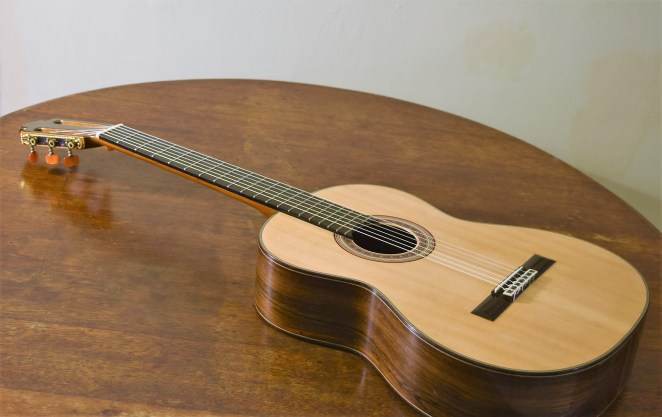
The guitar photographed here was hand built in 1979 by one of the important Japanese luthiers, Hiroshi Komori. It has his maker’s stamp on the label and a beautiful spruce top with jacaranda back and sides (jacaranda has been used quite often by Japanese luthiers and is sometimes referred to as the poor man’s Brazilian rosewood). I have not owned this guitar forever but like all great guitars I feel connected to it, almost like it was made for me. Check out the lyrics to Neil Young’s “This old guitar”- you’ll get the picture. Neil is referring to Hank William’s old pre-war Martin which Neil now has in his possession but he could very well be talking about my Komori or any other well loved and treasured instrument. The good ones certainly have a special character and like Neil’s ‘old guitar’, even though the Komori is an expensive instrument, just like my old Suzuki used to do, it leans comfortably against any wall and is rarely in its case. Every now and then it winks at me and demands to be played … Go figure.

Did you know …

dsc_0025-5

New York has long been known the world over as the “Big Apple”. The term was coined by touring jazz musicians from the 1930’s who used the word “apple” as a slang expression for any town or city they were performing in. New York was always considered the big city and jazz musician’s came from all over to play there because of the widely held belief that making it in New York meant that you had really made the big time. So to play in New York was to play in the Big Apple.

John Holland, Guitar Lessons Sydney Inner West, Strings and Wood, John Holland Guitars for Sale

The revolution that was bebop and the birth of modern jazz

DSC_0351 (2).JPGMiles Davis says in the prologue of his autobiography, “Listen. The greatest feeling I ever had in my life – with my clothes on – was when I first heard Diz and Bird together in St Louis, Missouri, back in 1944 … Man that shit was so terrible it was scary.”[1]

It must have been an amazing feeling to actually be there when the massive tidal wave that was bebop hit the music scene. For jazz musicians used to the easy swing of the big band era of the thirties and forties, this new musical invention must have been, as Miles suggested, ‘scary’. On another more egotistical level, there was a feeling of personal insult amongst many of the leading swing musicians of the 1940’s who saw this wild new music as a flagrant disrespect for the jazz that these old legends had fought so hard and suffered so much for. Certainly they were right, bebop was a departure from form. I would argue, however, that it is in fact a logical extension of swing’s fast four-four beat but without the uniformity of swing’s accents or the consistent beat of the bass drum.

In essence any common chord progression could be used in the bebop style because the progression was merely the harmonic vehicle to showcase the musicians’ virtuosic ability. Clearly this was not a music designed for easy listening, a fact that, as I have already suggested, would have upset older, more established musicians who were used to entertaining their audiences by giving them what could be easily enjoyed by the average listener. Bebop challenged these boundaries and promoted itself as an art form that required its audiences to listen intently rather than dance. This effectively removed jazz from the mainstream of popular music, which would have only polarised many of the jazz establishment even further.

Not that this would have concerned the ‘boppers’; the bebop message was never aimed at achieving mainstream acceptance. Its many detractors notwithstanding, it offered to its followers a chance to buck against accepted norms in much the same way that folk protest music and then rock music harnessed the voice of change in the 1960s. This was undoubtedly the case for young musicians like Miles – bebop was the chance that they had been waiting for. It was their opportunity to be part of a totally new musical direction that not only challenged the accepted status quo but gave the new generation a unique voice that set it apart from what had gone before. In the eyes of these young lions bebop was the hip new injection that jazz was waiting for and its creators Charlie Parker and Dizzy Gillespie were the new stars to be emulated. They and those like Miles who immediately followed them were not only young and supremely talented but bored and rebellious and committed to their art. In short, they lived for playing. Each one of them heard a fragment of the future. It was when they came together that ‘modern jazz’ was really born.

Keep music live.

[1] Miles Davis with Quincy Troupe., Miles: The autobiography, (New York: Simon and Schuster, 1989), p.V

Washburn Parlor Guitar, John Holland guitars, Sydney Inner West guitar lessons

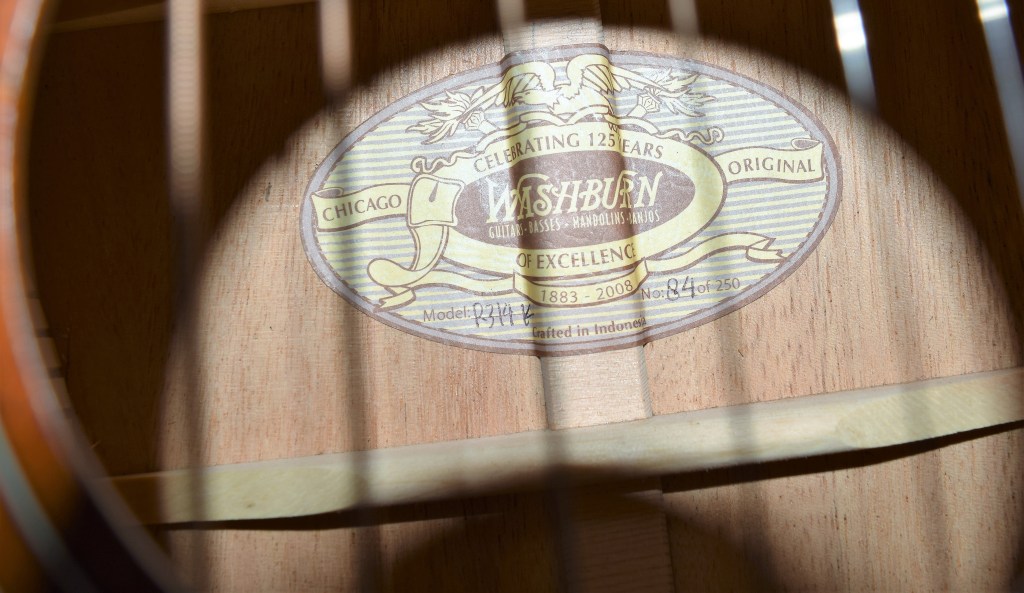
For Sale: Washburn R314 K Parlor Guitar Number 84 of 250 (Collector’s Edition)

In 2008, Washburn Guitars decided to celebrate 125 years as one of America’s premier guitar builders by initially offering for sale 250 individually numbered guitars from various iconic models they had built since their humble beginnings in 1883.

To authenticate the instruments even further, they were artificially “aged” to look like they were in fact 125 years old. These original 250 instruments are different from the later mass produced options in that the tops are solid, not laminate, and the build qualities are substantially better.

From the very beginning, the Parlor guitar was a staple for the Washburn company. The Parlor was a smaller bodied instrument that as the name suggests could be played in the small front parlor rooms of well-to-do homes. For me, though, the vision of a thousand old blues players singing away their troubles on these lovely little guitars is a far more appealing image. These guitars have such a great acoustic blues tone!

Smaller than a concert guitar, the Parlor guitar has had a major revival in the last decades and original pre-1900 instruments now fetch substantial dollars depending on their quality and condition. [For more information on this instrument go to Guitars: “For Sale: Washburn R314 K Parlor Guitar Number 84 of 250 (Collector’s Edition)“]


Price: $1050.00  (SOLD)

A thought for the day…


“A musician may suddenly reach a point at which pleasure in the technique of the art entirely falls away, and in some moment of inspiration he becomes the instrument through which music flows.” 

DSC_0343 (4).JPG

To achieve this state is rare but it does happen and it is always worth striving for. As one of my fantastic guitar students, Max Warland, wrote on my music room wall at the age of 11: “Get off your butt, stop eating cookies and strum your drum.” Max had a colourful way with words but I think you get his drift. Get moving and get on with it!

I often think that for many aspiring musicians the problem with their learning is that like many people they are looking for a final destination – a place where they can say they have finally arrived. Music doesn’t work like that. It is a constantly changing and evolving thing. If you can get that you will love it forever. Keep on strumming!


John Holland guitar lessons, Inner West Sydney, John Holland, Strings and Wood, Guitars for sale

Customising my Telecaster

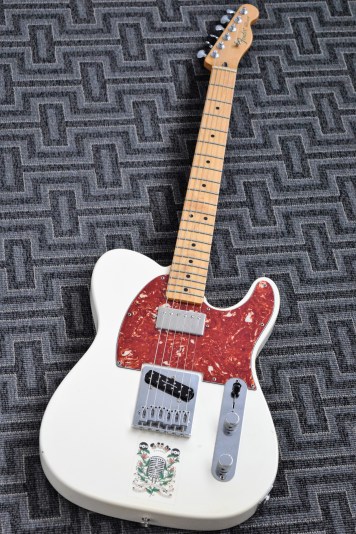
dsc_0078This is my go-to Telecaster. While I own quite a few others and they are all brilliant instruments this is the one that does most of the hard yards day in, day out. In my opinion, it is a cool looking guitar and it is the only one in my collection that has a sticker on it! I don’t normally put stickers on instruments – although, it’s been done so many times and often with iconic effect. Think Joe Strummers’ 66 Tele or wander further back to Woody Guthrie’s Gibson L-OO which he painted with the words “This Machine Kills Fascists”. While not wishing for anyone’s demise, I nevertheless decided that once the guitar was exactly to my liking I would add the sticker – kind of like a statement of ownership because this Tele was definitely not for sale. The fact that the sticker referred to the famous Sun Studios just added to this guitar’s mojo.

The guitar has had an interesting history. While both  the body and neck are originally from Fender’s Ensenada Factory in Mexico they come from different years . I found the neck on Ebay and bought it sight unseen. This is not always a good strategy but I have found that the Mexican parts have generally  been pretty reliable. I think the important thing is to ask every question and make sure your dealer has a good Ebay success rate (in my opinion 100% is preferable but 98.5% is acceptable. In both cases the transaction history should be reasonably high).

DSC_0059 (2).JPGWhen this neck arrived it was everything the seller said it was. The neck was brand new and had what appeared to be the Jim Dunlop 6150 fret wire – a medium high gauge wire that I particularly like. The next step was a body and I decided to go for a loaded Mexican body. There are plenty available on Ebay and I snapped up a typical single coil version with a mint green pickguard. Once neck and body were put together I had a no frills Tele that looked okay, sounded okay but in the end it was … well … just okay. Soon enough somebody offered me a fair price for it so I let it go. I figured that was the end of my Tele customising experiment until I got a phone call from the new owner some six months later asking if I would buy it back.

I agreed to take the guitar back and then had a think about what to do with it. The neck had a great feel but I wasn’t particularly excited about the standard Mexican pickups. I’d always loved the absolute “attitude” that seemed to scream from Keith Richards’ famous Tele that he’d dubbed “Micawber”. The key had been the perfect “mismatch” of the pickups – the old lap steel pickup in the bridge and the reversed 50’s Gibson Paf Humbucker in the neck.

I knew that these Mexican Tele’s had a rout for a humbucker in the neck position so I set about finding a great humbucker to put in the neck.

I was already a fan of Lollar pickups and once I realised that their Imperial pickup was switchable from humbucker to single coil my decision was made. The option of having the single coil is extremely useful for the performing guitarist. Work it out for yourself but if you apply the simple rule that the single coil will thin your sound while you’re playing rhythm, whereas the humbucker will fatten your sound in the solo sections you have a useful starting point.

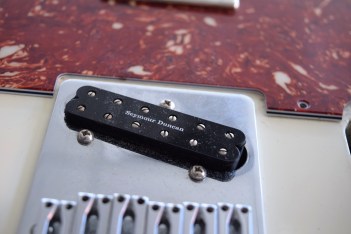
The next step was to decide on the bridge DSC_0040.JPGpickup. Fortunately the loaded body had already come with the modern individual saddles (think Keith’s brass saddles on Micawber but in nickel. Either way, so much easier to fine tune than the vintage options). For me, the Seymour Duncan Lil ’59 was a no brainer. I didn’t want the bridge pickup to be switchable and this pickup can really funk it up. A great contrast to the Lollar. It also fits into the bridge rout without any mucking about.

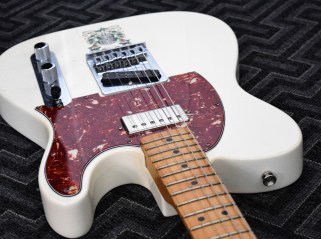
Something I forgot to mention is that I needed to change the pickguard so it was cut for a humbucker in the neck (see the first two photos). This can present problems because not all pickguards will fit, so beware! Like all things related to guitar, do your homework and you will be fine.

dsc_0050

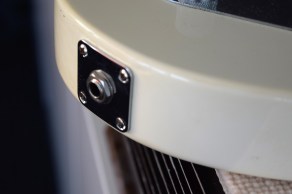
The next thing I did was change the socket from the “boat” style Fender Tele socket (a different boat option than its Stratocaster counterpart) to the more efficient Les Paul style socket. Now I felt that I was on the home stretch but there was one last detail that I needed to attend to make this the optimum performing machine.

DSC_0062.JPG

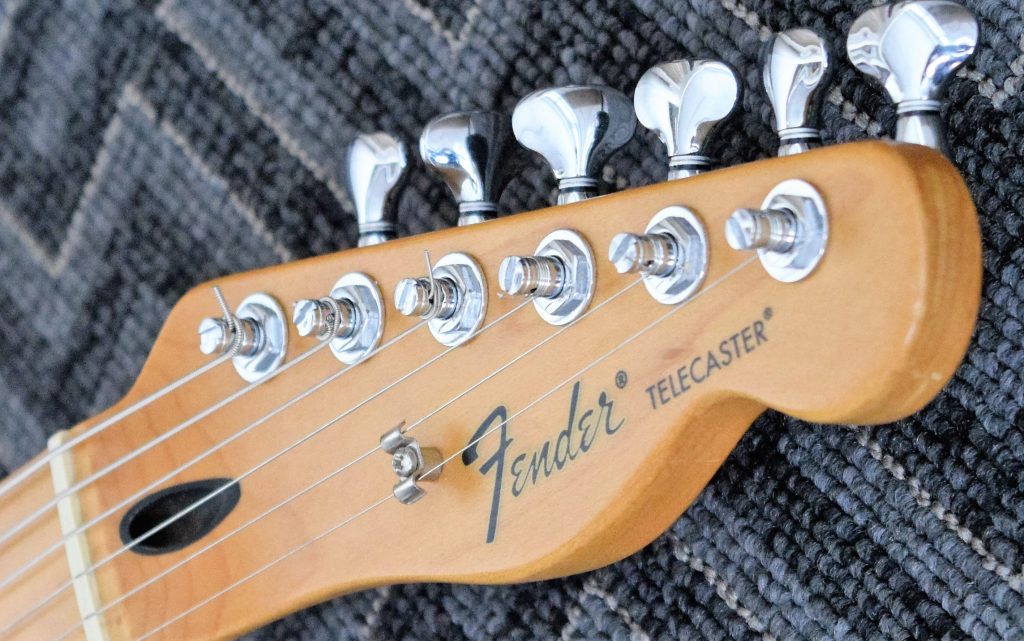
I love the Gotoh 510 tuners. I use them on my acoustic guitars and for this project I used the locking mini tuners. They are 18:1 gear ratio and are extremely efficient. Yes, they are a little more expensive but they are definitely worth the few extra dollars.

Finally, please note that after so much attention to detail in preparing this project I had no hesitation in allowing a qualified technician to do all the necessary soldering and final set-up for me. As I have mentioned in previous posts the good guitar technicians are out there and they are worth the expense. In this case Alan Rigg (look him up) was the man to join the dots for me and his attention to detail was absolutely invaluable.

What has come from the experience is an extremely fine guitar that hasn’t broken the bank, and will have a long playing history for many, many years to come.

Guitars, guitar lessons, John Holland, Sydney Inner West, John Holland, Strings and Wood, Guitars for sale

To restore or not to restore? That is the question

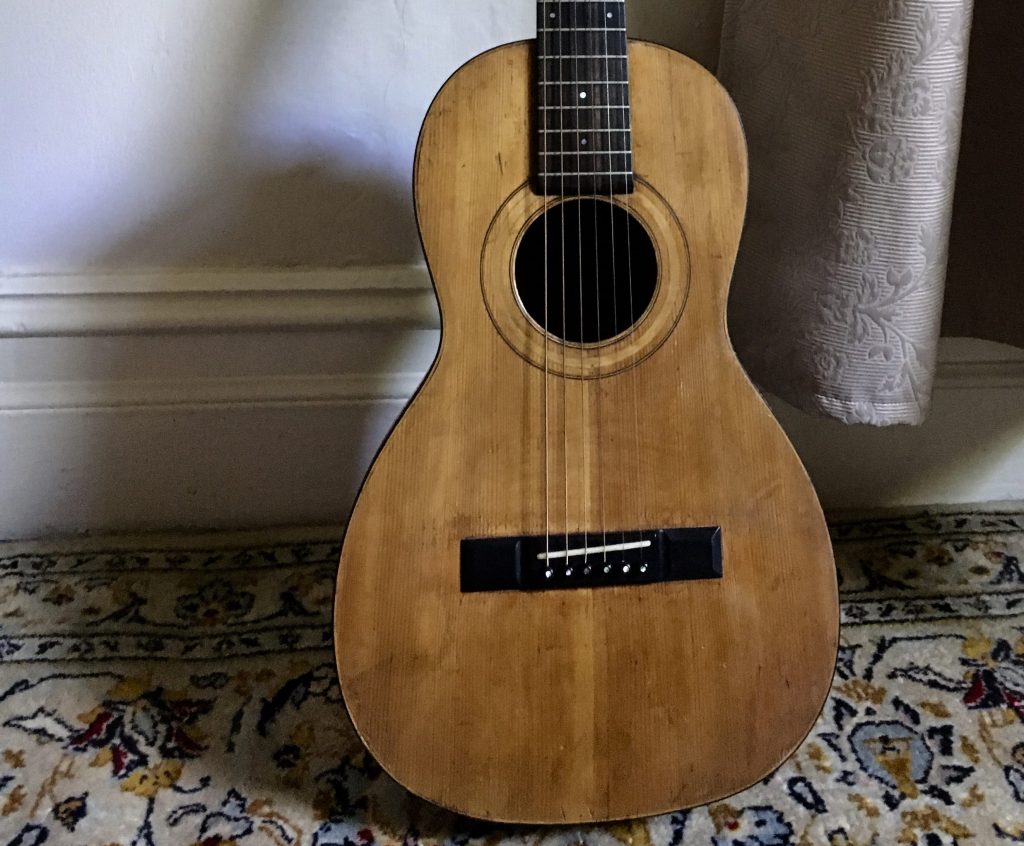
The photo that you see above is of an American parlor guitar made sometime between 1870 and 1890. It could even be earlier because its shape is reminiscent of the style of parlor that was made in the US in the years immediately following the American civil war.

Many of these post-war instruments were made of oak but this lovely example definitely displays a higher grade of material. It has a beautiful original spruce top and absolutely stunning Brazilian Rosewood back and sides.

When I purchased the guitar from the US I paid (AUD)$950.00 and was assured by the seller that the instrument was “perfectly playable”. When it arrived my excitement was seriously dampened, however, because the guitar was anything but playable. It could not hold tune, even for a moment, and I knew I was in for some serious money if I was going to save what had clearly been an amazing instrument in its time.

The one thing the guitar had going for it was that it was relatively intact, although it had some large structural cracks on the body. The most noticeable attribute of this orphan was the tone that came out of its fractured body when I plucked the rusty low “Ë” string, which, I might add, was one of only three strings the seller had bothered to leave on the guitar before sending it across the sea.

It is hard to not believe that said seller felt this little relic was nothing more than a “lemon”. But now it was my lemon and I had to decide what to do with it. If I sent it back not only would I have to pay the substantial postage fee with no hope of recompense, but I would undoubtedly be dooming this little piece of history to a barn wall until rot and neglect finally kicked in for good. So where to go to next?

As a working musician I am lucky enough to work with a couple of guitar technicians who are absolutely without peer when it comes to diagnosing and fixing problems of the guitar kind. In Sydney these days it seems that anyone can set themselves up as a so-called “guitar expert” but after so long in the game I know the real experts are relatively few and far between. That said, there are a few geniuses out there and I strongly urge engaging their services when it comes to setups and the like. Look them up, it will be worth your effort.

So back to my parlor and the pressing problem of where to go to next. It was suggested by one of my set-up guys that I should get in contact with Jeff Malia, a local luthier and the go to person for all things related to guitar restoration. I had heard of Jeff and knew two things about him. Firstly that he was the best in the business when it came to restoration and, secondly, that he was absolutely painstaking when it came to attention to detail. What I didn’t know was what an incredible luthier he is and, most importantly, what an absolutely honest and caring human being he is. It goes without saying that once I met him I knew that my little piece of history was in the right hands.
John Holland, Guitar lessons, Sydney Inner West, John Holland, Strings and Wood, Guitars for sale

Jeff commented firstly on the high quality of the timbers used in the guitar. He then put a large stethoscope-like instrument in the sound hole and informed me that the instrument had a makers mark on the underside of the top. Jeff suggested the guitar was probably built in New York by one of the eight builders that existed in the 1870s/80s in that city. So now I knew I had a guitar of indeterminate beginnings but the question was “is it saveable?” Jeff’s answer was simple: “It comes down to how much you’re willing to spend”. Having come this far and knowing the guitar would now be in Jeff’s hands for many months, which meant I had time to organise the finances, it was really a no brainer for me. This little beauty had to be restored.

The restoration began in March 2012 and while keeping in vague touch with Jeff over the next nine months it wasn’t until the week before Christmas that I received an email from him to say the operation had been successful and the guitar would be ready for collection on Christmas eve.

What greeted me on that day was a truly beautiful sounding instrument that punched way above its weight. That first strum was an absolutely magical moment – what an incredible sounding guitar!

We still had another restorative stage to consider – that being tidying up the look of the instrument, but we decided that this was a consideration for a later date. Now four years on I am still yet to decide whether to take that next step.

I have often taken the guitar with me to the courses I run and enjoy the look on students faces as they hear the sound that the guitar generates, but I am yet to come to a clear decision as to whether to do the next stage of the restoration. I suppose the question is how much do I adjust the guitar’s essential DNA. Do we completely cover up a few well-repaired cracks for aesthetic reasons or are they better left alone as an acknowledgement of the guitars 140 year history. I suppose this might be the question for another post.

As an aside, I contacted the seller after getting Jeff’s diagnosis and told him that while I would not be sending the guitar back even though I was going to be seriously out of pocket, it might be useful that in the future he told the truth about items he was seeking to sell. To his credit and without any prompting from me he deposited $250.00 back into my account. 🙂