John Holland guitar lessons, Inner West Sydney, John Holland, Strings and Wood, Guitars for sale

Customising my Telecaster

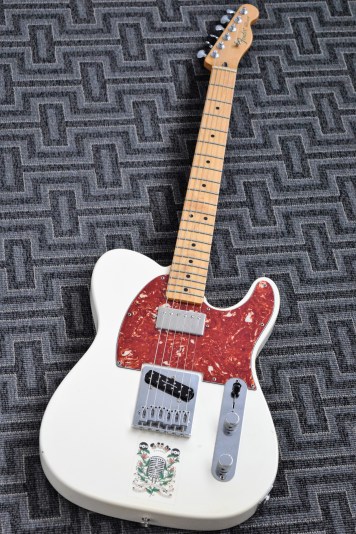
dsc_0078This is my go-to Telecaster. While I own quite a few others and they are all brilliant instruments this is the one that does most of the hard yards day in, day out. In my opinion, it is a cool looking guitar and it is the only one in my collection that has a sticker on it! I don’t normally put stickers on instruments – although, it’s been done so many times and often with iconic effect. Think Joe Strummers’ 66 Tele or wander further back to Woody Guthrie’s Gibson L-OO which he painted with the words “This Machine Kills Fascists”. While not wishing for anyone’s demise, I nevertheless decided that once the guitar was exactly to my liking I would add the sticker – kind of like a statement of ownership because this Tele was definitely not for sale. The fact that the sticker referred to the famous Sun Studios just added to this guitar’s mojo.

The guitar has had an interesting history. While both  the body and neck are originally from Fender’s Ensenada Factory in Mexico they come from different years . I found the neck on Ebay and bought it sight unseen. This is not always a good strategy but I have found that the Mexican parts have generally  been pretty reliable. I think the important thing is to ask every question and make sure your dealer has a good Ebay success rate (in my opinion 100% is preferable but 98.5% is acceptable. In both cases the transaction history should be reasonably high).
DSC_0059 (2).JPGWhen this neck arrived it was everything the seller said it was. The neck was brand new and had what appeared to be the Jim Dunlop 6150 fret wire – a medium high gauge wire that I particularly like. The next step was a body and I decided to go for a loaded Mexican body. There are plenty available on Ebay and I snapped up a typical single coil version with a mint green pickguard. Once neck and body were put together I had a no frills Tele that looked okay, sounded okay but in the end it was … well … just okay. Soon enough somebody offered me a fair price for it so I let it go. I figured that was the end of my Tele customising experiment until I got a phone call from the new owner some six months later asking if I would buy it back.

I agreed to take the guitar back and then had a think about what to do with it. The neck had a great feel but I wasn’t particularly excited about the standard Mexican pickups. I’d always loved the absolute “attitude” that seemed to scream from Keith Richards’ famous Tele that he’d dubbed “Micawber”. The key had been the perfect “mismatch” of the pickups – the old lap steel pickup in the bridge and the reversed 50’s Gibson Paf Humbucker in the neck.

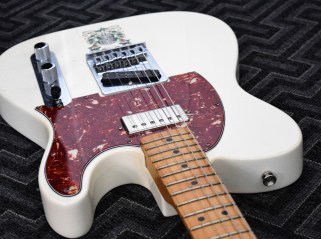
I knew that these Mexican Tele’s had a rout for a humbucker in the neck position so I set about finding a great humbucker to put in the neck.

I was already a fan of Lollar pickups and once I realised that their Imperial pickup was switchable from humbucker to single coil my decision was made. The option of having the single coil is extremely useful for the performing guitarist. Work it out for yourself but if you apply the simple rule that the single coil will thin your sound while you’re playing rhythm, whereas the humbucker will fatten your sound in the solo sections you have a useful starting point.

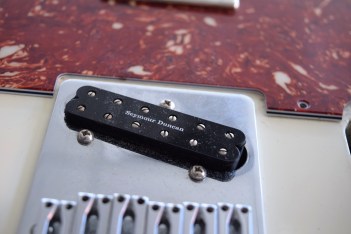
The next step was to decide on the bridge DSC_0040.JPGpickup. Fortunately the loaded body had already come with the modern individual saddles (think Keith’s brass saddles on Micawber but in nickel. Either way, so much easier to fine tune than the vintage options). For me, the Seymour Duncan Lil ’59 was a no brainer. I didn’t want the bridge pickup to be switchable and this pickup can really funk it up. A great contrast to the Lollar. It also fits into the bridge rout without any mucking about.
Something I forgot to mention is that I needed to change the pickguard so it was cut for a humbucker in the neck (see the first two photos). This can present problems because not all pickguards will fit, so beware! Like all things related to guitar, do your homework and you will be fine.
dsc_0050

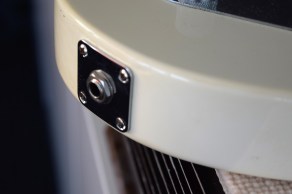
The next thing I did was change the socket from the “boat” style Fender Tele socket (a different boat option than its Stratocaster counterpart) to the more efficient Les Paul style socket. Now I felt that I was on the home stretch but there was one last detail that I needed to attend to make this the optimum performing machine.

DSC_0062.JPG

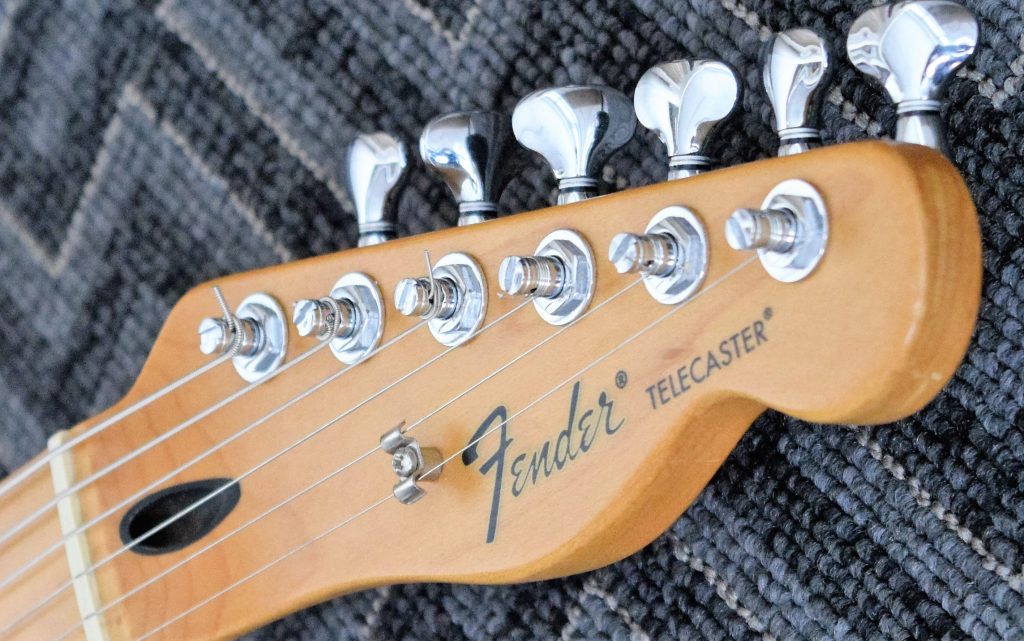
I love the Gotoh 510 tuners. I use them on my acoustic guitars and for this project I used the locking mini tuners. They are 18:1 gear ratio and are extremely efficient. Yes, they are a little more expensive but they are definitely worth the few extra dollars.

Finally, please note that after so much attention to detail in preparing this project I had no hesitation in allowing a qualified technician to do all the necessary soldering and final set-up for me. As I have mentioned in previous posts the good guitar technicians are out there and they are worth the expense. In this case Alan Rigg (look him up) was the man to join the dots for me and his attention to detail was absolutely invaluable.

What has come from the experience is an extremely fine guitar that hasn’t broken the bank, and will have a long playing history for many, many years to come.
Jimi Hendrix, John Holland, Sydney Inner West guitar lessons, guitars

The blues ain’t nothin’ … then again

I have often wondered if the blues has been given the respect it deserves as an important stepping stone in the development of 20th Century popular music. Certainly for afficionados and those who embrace it, the blues can have an almost mystical character that is rich in tradition and offers a unique musical folklore that must be preserved.

Lovers of the genre can spend whole lifetimes trying to uncover the truths or otherwise of the many stories that have been woven into its history. For these people the blues is very much alive, complete with a cast of characters whose very names continue to inspire awe and appreciation among devotees; names like Charlie Patton, Son House, Robert Johnson, Mississippi John Hurt, Bessie Smith, Hound Dog Taylor, Memphis Minnie, Memphis Slim, Etta James and millions of others who tell a story of the blues and add their own take to the narrative, in some way helping to ensure the idiom’s mystique is maintained.

Did Robert Johnson really sell his soul to the devil at the crossroads? The implication is that the transaction ensured his fabulous guitar skills but, because of his benefactor, probably also played a hand in his early death. Even the way that Robert died has never been confirmed with any certainty, leaving us forevermore with a wonderful yet dark mystery that has become the stuff of legend and songs. Speaking of songs, we have as a direct connection to the man Johnson’s 1936/37 recordings of 29 songs recorded in two sessions and the only songs he recorded before his untimely death. You can almost see his uncommonly long fingers caressing the fingerboard of his 1929 Gibson L-1 (or was it his Kalamazoo KG-14?) while playing directly to the wall so that he got the best recorded sound for the engineer on the session. Each of the 29 songs were recorded twice and then the session was done, and reportedly not that long after so was Robert.

jimmy-2

The history of the blues is littered with such stories. Was Leadbelly finally released from prison into the hands of Alan and John Lomax because he had written a song for the jail warden’s wife? The song, Goodnight Irene, became a huge seller, some say, with a million copies when piano rolls, sheet music and acetate (78 records, for anyone born after 1990) were taken into account. It’s a great story and far more colourful than the truth but suffice to say Leadbelly was finally released from jail and had a major impact during America’s early 60s folk boom and died a free man. Diverse musicians across the musical spectrum from Bob Dylan to Eric Clapton to Kurt Cobain have paid homage to the musical spirit that is Leadbelly. Who can forget Cobain’s gut wrenching version of Where did you sleep last night? on his MTV Unplugged in New York album? Yes indeed, the blues has the power to reach across the decades.

Was Bessie Smith murdered just when she was re-emerging as a musical force after years of alcohol and drug abuse? Regardless, hers is a sad story. Bessie was certainly a trail blazer for her time and I don’t believe her role has ever been fully acknowledged. While there had been female blues notables prior to her arrival in the late 1920’s, the idea of women playing and singing the blues had nowhere near as much importance attached to it as was attached to the role of the male “Bluesman”. Bessie’s eventual demise, clouded by serious substance abuse, was arguably hastened by the fact that she as a woman had to endure much more derision purely because she was born of the sex not to be taken as seriously as she should have been. Thankfully, there are great female blues performers out there today who would have no trouble acknowledging the roles Bessie and her contemporaries played in their careers. Think of the wonderful slide playing of Bonnie Raitt, and more recently the rootsy playing of Dani Wilde, and the blues attack of Samantha Fish. I’ve always believed there is great opportunity for committed and talented women in the field and there is so much more to be written from the female perspective. Personally, I’m all ears.

There is no doubt there remains a treasure chest of fact and fiction in the history of the blues but what does this mean to young musicians of the 21st Century desperate to make their mark in this highly technological age? Does an understanding of the blues have any relevance in their musical development? As a guitarist and teacher I have consistently argued that a good understanding of the blues provides an important stepping off point for a positive musical development in other areas of Western music. For me it provides the perfect example of a ‘less is more’ approach to music-making, which is a useful lesson for all guitarists and musicians generally and it also provides a solid base for the development of important improvisational skills. It is a music that can enforce a high level of technical aptitude in the player but can also be a powerful statement in its most primitive form. I have so often heard the criticism that it is a simplistic form of music but it is so much more than that. It has a depth that has spanned over a century and, when its roots in Africa are considered, well beyond 100 years. In a conversation not long before his passing, John Lee Hooker, one of the finest exponents of the genre offered this definition of the blues:

“The Blues is life, it’s as simple as that … The music we play, me, BB King, people like that, the music is the roots. Rock music, everything else, is like a branch on the same tree. It all comes from the blues. They dress it up a little, but it’s the same thing … Lots of friends of mine, who played the real blues: Muddy Waters, Albert King, Stevie Ray Vaughan, they’ve all gone. But their music is still here. The Blues will never die. Long as the world is going, the Blues will be here.”
John Holland, guitar Teacher, Sydney Inner West, Artist Guitars St Peters, John Holland, Strings and wood. Guiatrs for sale

Artist Guitars Solid Wood OM Acoustic Guitar demo

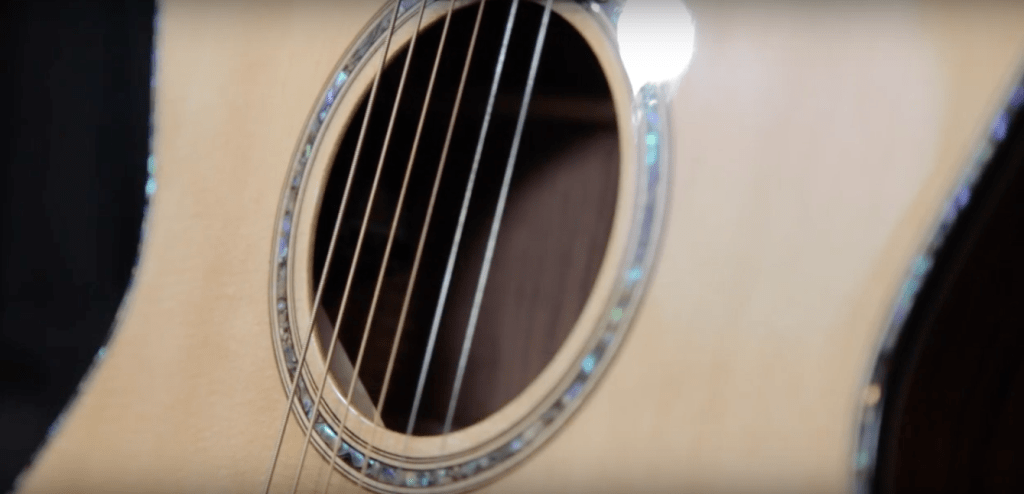
I’ve had the pleasure of working with Artist Guitars in the development of a higher end acoustic model. We based this beautiful instrument on the pre-war Martin style. The result is that we came up with a great and affordable, in relative terms, guitar. Check out the YouTube demo:

For more information go to Artist Guitars.

Guitars, guitar lessons, John Holland, Sydney Inner West, John Holland, Strings and Wood, Guitars for sale

To restore or not to restore? That is the question

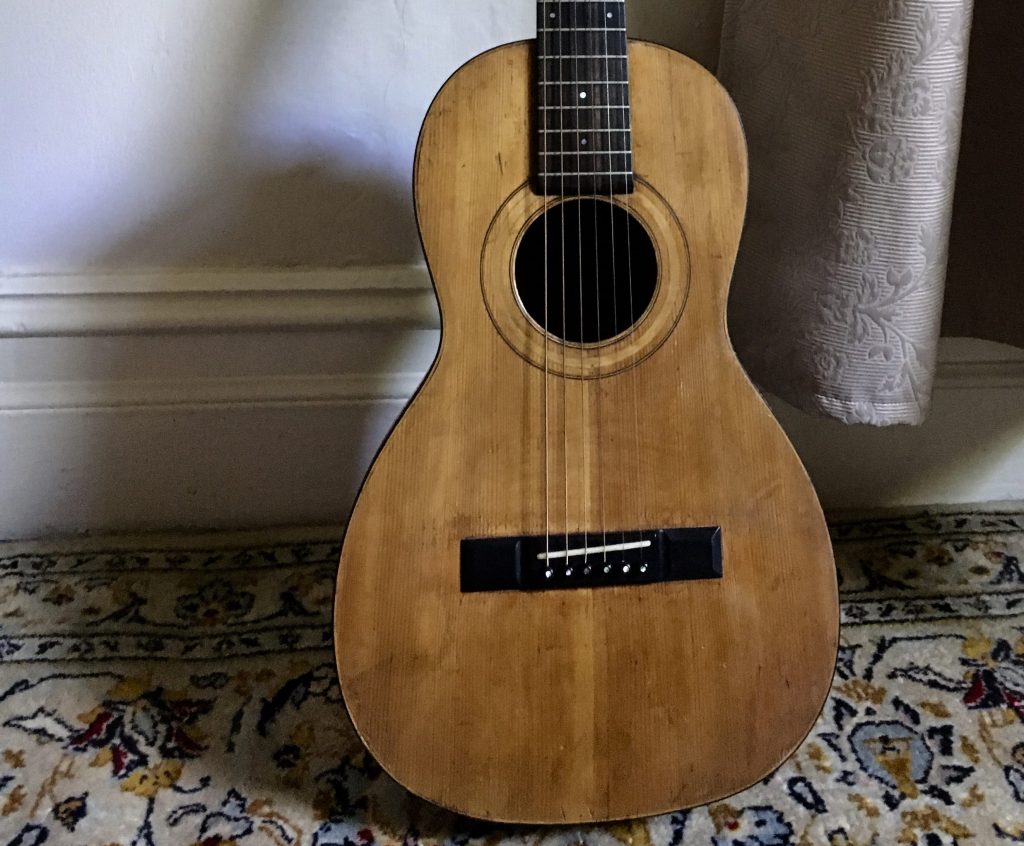
The photo that you see above is of an American parlor guitar made sometime between 1870 and 1890. It could even be earlier because its shape is reminiscent of the style of parlor that was made in the US in the years immediately following the American civil war.

Many of these post-war instruments were made of oak but this lovely example definitely displays a higher grade of material. It has a beautiful original spruce top and absolutely stunning Brazilian Rosewood back and sides.

When I purchased the guitar from the US I paid (AUD)$950.00 and was assured by the seller that the instrument was “perfectly playable”. When it arrived my excitement was seriously dampened, however, because the guitar was anything but playable. It could not hold tune, even for a moment, and I knew I was in for some serious money if I was going to save what had clearly been an amazing instrument in its time.

The one thing the guitar had going for it was that it was relatively intact, although it had some large structural cracks on the body. The most noticeable attribute of this orphan was the tone that came out of its fractured body when I plucked the rusty low “Ë” string, which, I might add, was one of only three strings the seller had bothered to leave on the guitar before sending it across the sea.

It is hard to not believe that said seller felt this little relic was nothing more than a “lemon”. But now it was my lemon and I had to decide what to do with it. If I sent it back not only would I have to pay the substantial postage fee with no hope of recompense, but I would undoubtedly be dooming this little piece of history to a barn wall until rot and neglect finally kicked in for good. So where to go to next?

As a working musician I am lucky enough to work with a couple of guitar technicians who are absolutely without peer when it comes to diagnosing and fixing problems of the guitar kind. In Sydney these days it seems that anyone can set themselves up as a so-called “guitar expert” but after so long in the game I know the real experts are relatively few and far between. That said, there are a few geniuses out there and I strongly urge engaging their services when it comes to setups and the like. Look them up, it will be worth your effort.

So back to my parlor and the pressing problem of where to go to next. It was suggested by one of my set-up guys that I should get in contact with Jeff Malia, a local luthier and the go to person for all things related to guitar restoration. I had heard of Jeff and knew two things about him. Firstly that he was the best in the business when it came to restoration and, secondly, that he was absolutely painstaking when it came to attention to detail. What I didn’t know was what an incredible luthier he is and, most importantly, what an absolutely honest and caring human being he is. It goes without saying that once I met him I knew that my little piece of history was in the right hands.

John Holland, Guitar lessons, Sydney Inner West, John Holland, Strings and Wood, Guitars for sale

Jeff commented firstly on the high quality of the timbers used in the guitar. He then put a large stethoscope-like instrument in the sound hole and informed me that the instrument had a makers mark on the underside of the top. Jeff suggested the guitar was probably built in New York by one of the eight builders that existed in the 1870s/80s in that city. So now I knew I had a guitar of indeterminate beginnings but the question was “is it saveable?” Jeff’s answer was simple: “It comes down to how much you’re willing to spend”. Having come this far and knowing the guitar would now be in Jeff’s hands for many months, which meant I had time to organise the finances, it was really a no brainer for me. This little beauty had to be restored.

The restoration began in March 2012 and while keeping in vague touch with Jeff over the next nine months it wasn’t until the week before Christmas that I received an email from him to say the operation had been successful and the guitar would be ready for collection on Christmas eve.

What greeted me on that day was a truly beautiful sounding instrument that punched way above its weight. That first strum was an absolutely magical moment – what an incredible sounding guitar!

We still had another restorative stage to consider – that being tidying up the look of the instrument, but we decided that this was a consideration for a later date. Now four years on I am still yet to decide whether to take that next step.

I have often taken the guitar with me to the courses I run and enjoy the look on students faces as they hear the sound that the guitar generates, but I am yet to come to a clear decision as to whether to do the next stage of the restoration. I suppose the question is how much do I adjust the guitar’s essential DNA. Do we completely cover up a few well-repaired cracks for aesthetic reasons or are they better left alone as an acknowledgement of the guitars 140 year history. I suppose this might be the question for another post.

As an aside, I contacted the seller after getting Jeff’s diagnosis and told him that while I would not be sending the guitar back even though I was going to be seriously out of pocket, it might be useful that in the future he told the truth about items he was seeking to sell. To his credit and without any prompting from me he deposited $250.00 back into my account. 🙂